

 Français
 Italiano
 Español
ILLUSTRATIVE SCENARIO · APPLICATION TO BE STUDIEDDesign a reception area.
Design a reception area.
Without losing track of the modules.
A furniture manufacturer and a fit-out contractor.
01 / THE PROBLEMWhat gets stuck
What gets stuck
today.
The fit-out contractor assembles modules, decors, returns and accessories from several documents. A finish reference or the direction of a return can be wrongly carried over into the request.
A REAL-WORLD REQUEST
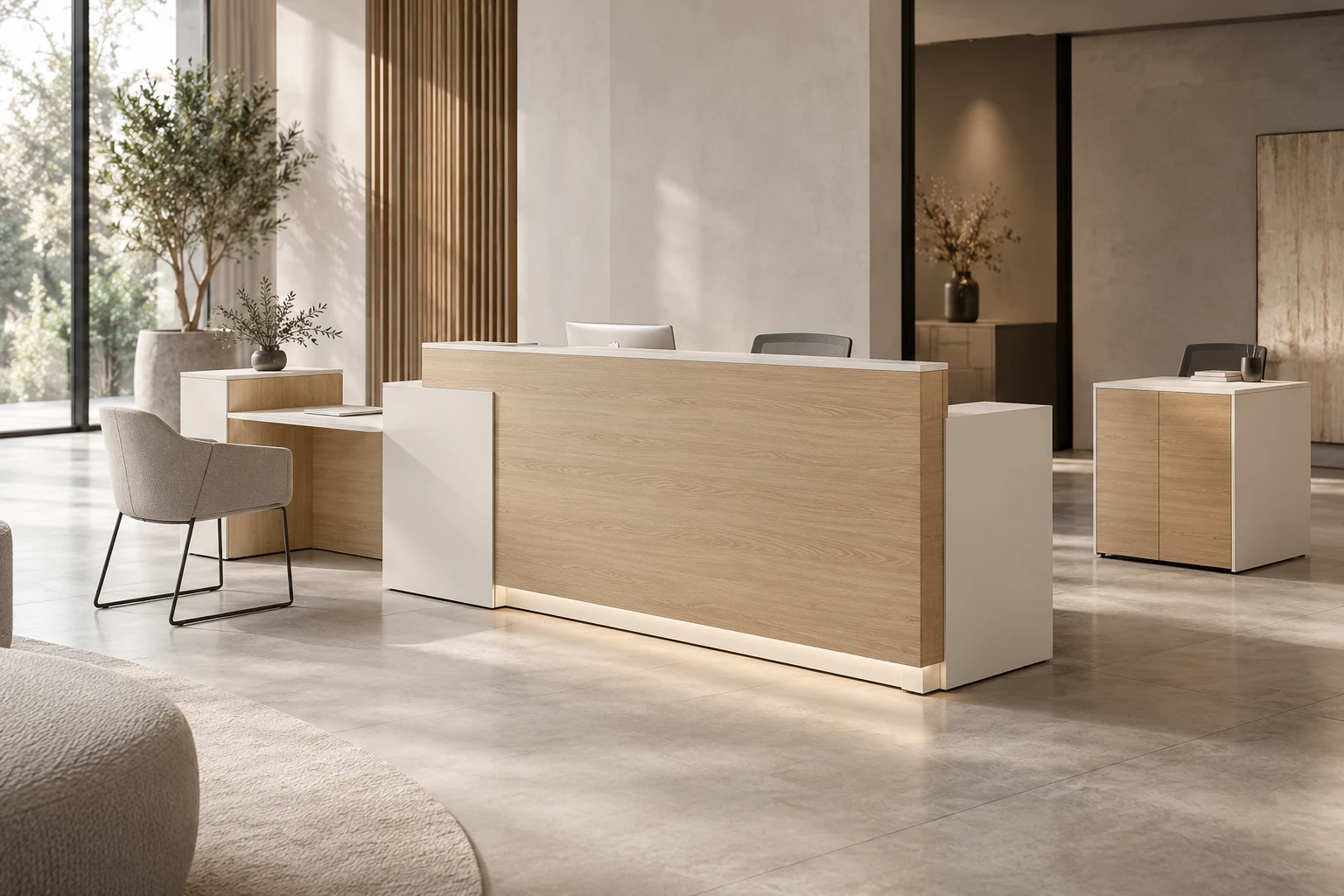
Design a reception desk with a 2,400 mm main module, a 1,200 mm return, a lowered section and a light oak / white finish.
02 / THE PROPOSED CONFIGURATIONClear parameters.
01 02 03
Clear parameters.
Guided decisions.
SAMPLE SPECIFICATION · NON-CONTRACTUAL
Main module2,400 mm
Return1,200 mm
LayoutLowered section + return
FinishesLight oak / white
What the Cortex should check
- Offer only the modules and assemblies that exist in the range.
- Check the direction of the return, the joints and the finishes available for each element.
- Identify access and transport constraints and the accessibility validations required.
Match modules and finishes
Summarise the whole
03 / BEYOND THE CORTEXMadus links
Madus links
the whole deal.
The fit-out contractor keeps the project in their customer file and quotes with their supplier terms. The manufacturer receives an explicit layout to process the deal and prepare the expected items.
Discover management and steering ↗04 / THE EXPECTED OUTPUT
A file ready to use.
Including a lowered section does not, on its own, validate the accessibility of the project.
madusSAMPLE FILE
Office furniture
- List of selected modules and accessories
- Summary of finishes per element
- Quote and layout validation file
No made-up prices: quoting would use the price grids, rules and terms validated by the supplier.
A business question.
Can the Cortex handle several finishes?
Yes, if these choices and their compatibilities are modelled in the range. Availability and assembly constraints must be provided by the manufacturer.
To carry out this project, we would need to gather the catalogue or offer, the rules, the price grids and validated examples. The scope and feasibility would then be defined together.
More time to sell.
More visibility to act.
Let’s see how Madus can support your company and your network.
Request a demo ↗